Tickets for an opera-ballet combination, "C'est la guerre" and "The Tricky Students," were $12 each.

St. Stephen's Cathedral. �
�
The Gresham Palace is on the river, facing Buda. It was obviously once a grand building in the Secession Style but is now a wreck
(it's going to be turned into a Four Seasons Hotel).
 �
�
The first photograph is the Elizabeth Bridge (but maybe that's not the right name),the lions on the Pest side; the second picture is the bridge from the funicular that goes up the hill into the old city of Buda.
 �
� �
�  �
�
From the National Gallery, overlooking the Parliament buildings in Pest.
 �
�
The statue of King Stephen outside St. Matthew's Church, on the Buda crestover looking Pest. �
�
The church of St. Matthew. �
�
 �
�
 �
�The Central Food Market is one of the great sights of Budapest.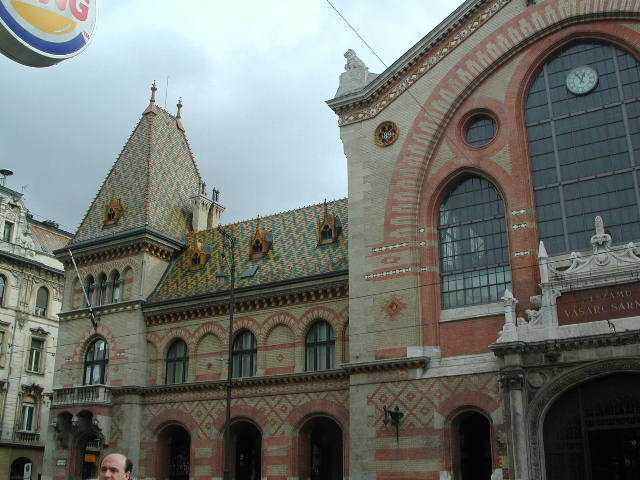 �
�
 �
�
 �
� �
�
The Museum of Applied Arts, where we saw a first-rate exhibition of Secession furniture, glass, and other art.
 �
�
 � appart1.jpg
 �
�
 �
�
 �
�
One of the city's nicest caf�s caught us in a good mood on our last day there.

We remember this street because we were accosted by police who tried to shake us down for US currency; someone was asking us for directions (a ruse) and his buddies, not really police, we think, claimed to be protecting us.
They actually looked in our wallets (which we showed them because we knew they were empty)!